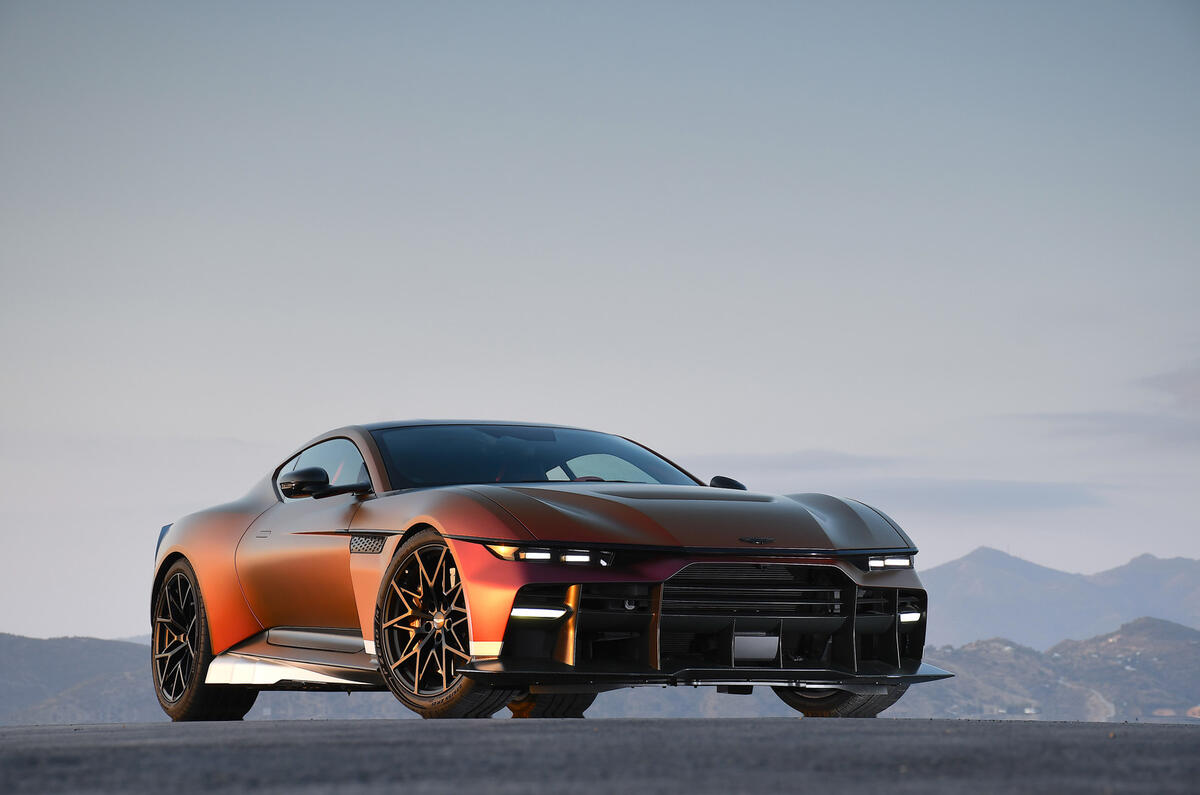
Aston Martin has spent the last three years proving that the front-engined V12 still has somewhere to go. The Valen is the clearest statement of that argument yet: 838 hp from a 5.2-litre twin-turbo V12, up to 110 kg pulled out of the car, a carbon fibre body designed to make downforce without a single motorsport wing, and a production run capped at 150 cars worldwide.
Revealed at Monterey Car Week in August 2026, the Valen is the latest V12 special from Q by Aston Martin, the marque's bespoke division, and it arrives with a specific claim attached: the most powerful front-engined production car in the world, and the most powerful front-engined car Aston Martin has built in its 113-year history.
Here is what the car actually is, what it costs, and why a two-seat British V12 built in a run of 150 matters to Gulf collectors in particular.
Aston Martin Valen: The Numbers at a Glance
| Specification | Figure |
|---|---|
| Engine | 5.2-litre twin-turbocharged V12 |
| Power | 838 hp (850 PS) at 6,500 rpm |
| Torque | 738 lb-ft (1,000 Nm) from 2,500 to 5,000 rpm |
| Transmission | 8-speed ZF transaxle, rear-wheel drive |
| 0-60 mph | 3.0 seconds |
| 0-100 km/h | 3.1 seconds |
| Top speed | 214 mph (344 km/h) |
| Weight saving | Up to 110 kg versus the core V12 architecture |
| Weight distribution | 53:47 front to rear |
| Wheels and tyres | 21-inch magnesium, Pirelli P Zero R, 275/35 front, 325/30 rear |
| Brakes | 410 mm front, 360 mm rear carbon ceramic |
| Production | 150 cars worldwide |
| Price | From about $2 million (roughly £1.5 million) before personalisation |
| Deliveries | Second quarter of 2027 |
The Most Powerful Front-Engined Aston Martin Ever Built
The Valen runs the most potent version of Aston Martin's 5.2-litre twin-turbo V12 yet built. Peak power is 838 hp, quoted as 850 PS, arriving at 6,500 rpm, with 738 lb-ft of torque available in a broad plateau from 2,500 rpm all the way to 5,000 rpm. There is no hybrid system, no electric axle and no torque fill: this is a combustion engine doing all of the work.
That figure is what earns the headline. Aston Martin claims the Valen as the world's most powerful front-engined production car, and as the most powerful front-engined car the company has produced in 113 years of building them. The Valkyrie and Valhalla make more power overall, but both are mid-engined and hybrid-assisted, which puts them in a different category entirely.
Eight Speeds, No Manual
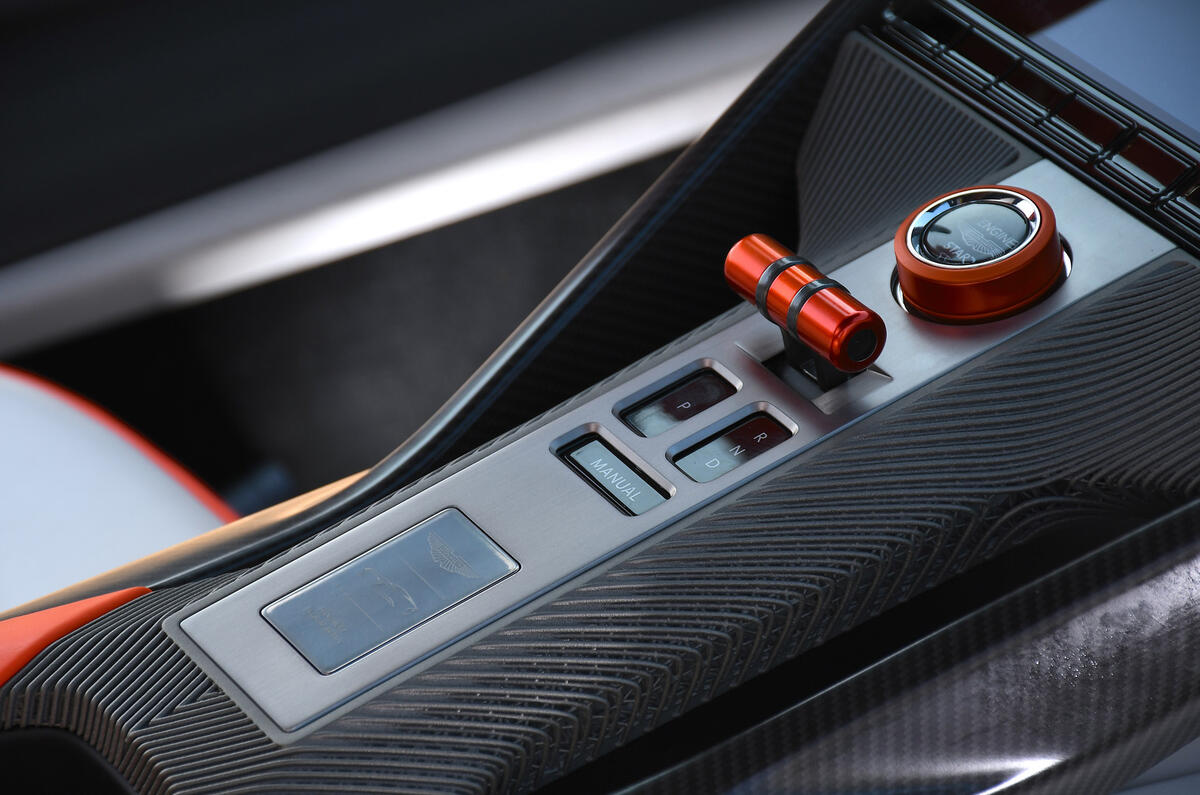
Unlike the Valour and the Valiant, the two V12 specials that preceded it, the Valen does not offer a manual gearbox. Power goes rearward through an eight-speed ZF transaxle, with shift programming that Aston Martin says was influenced by its Vantage GT4 racing cars.
That is a deliberate change of character rather than a cost saving. The Valour and Valiant were built around the act of shifting; the Valen is built around the numbers, and 738 lb-ft arriving at 2,500 rpm is more than most three-pedal transmissions want to see.
- Gearbox: 8-speed ZF transaxle
- Shift calibration: derived from Vantage GT4 race programming
- Drive: rear-wheel drive only
110 kg Lighter, and Every Gram Is Accounted For
Power is only half of the equation. The Valen sheds up to 110 kg (about 243 lb) against Aston Martin's core V12 architecture through carbon fibre, titanium and lightweight alloys, and the result is a near-ideal 53:47 front-to-rear weight distribution for a car with a V12 ahead of the cabin.
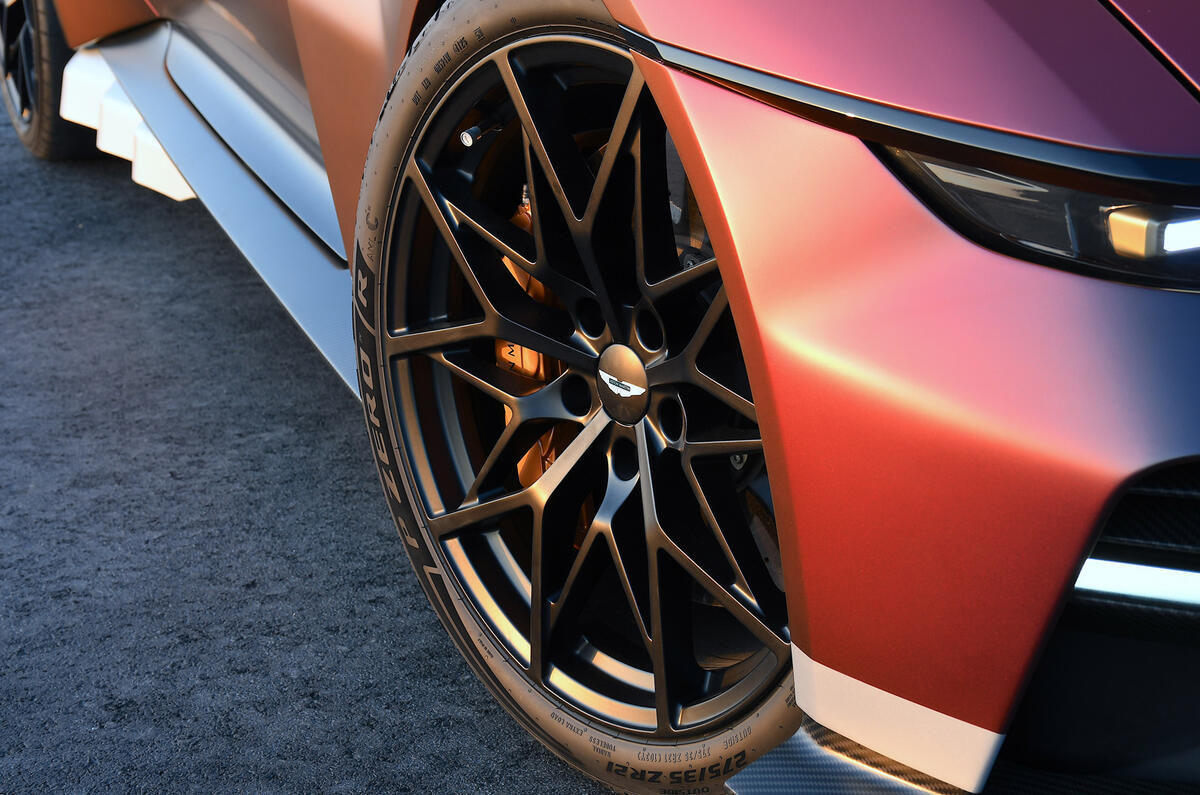
The body panels are all-new carbon fibre, offered painted, tinted or as exposed weave over the aluminium structure. Twenty-one-inch magnesium wheels come as standard, cutting unsprung mass to sharpen steering response, wheel control and ride quality at the same time. The quad-exit titanium exhaust with its micro-mufflers alone accounts for 14.8 kg of the saving.
Downforce Without a Wing
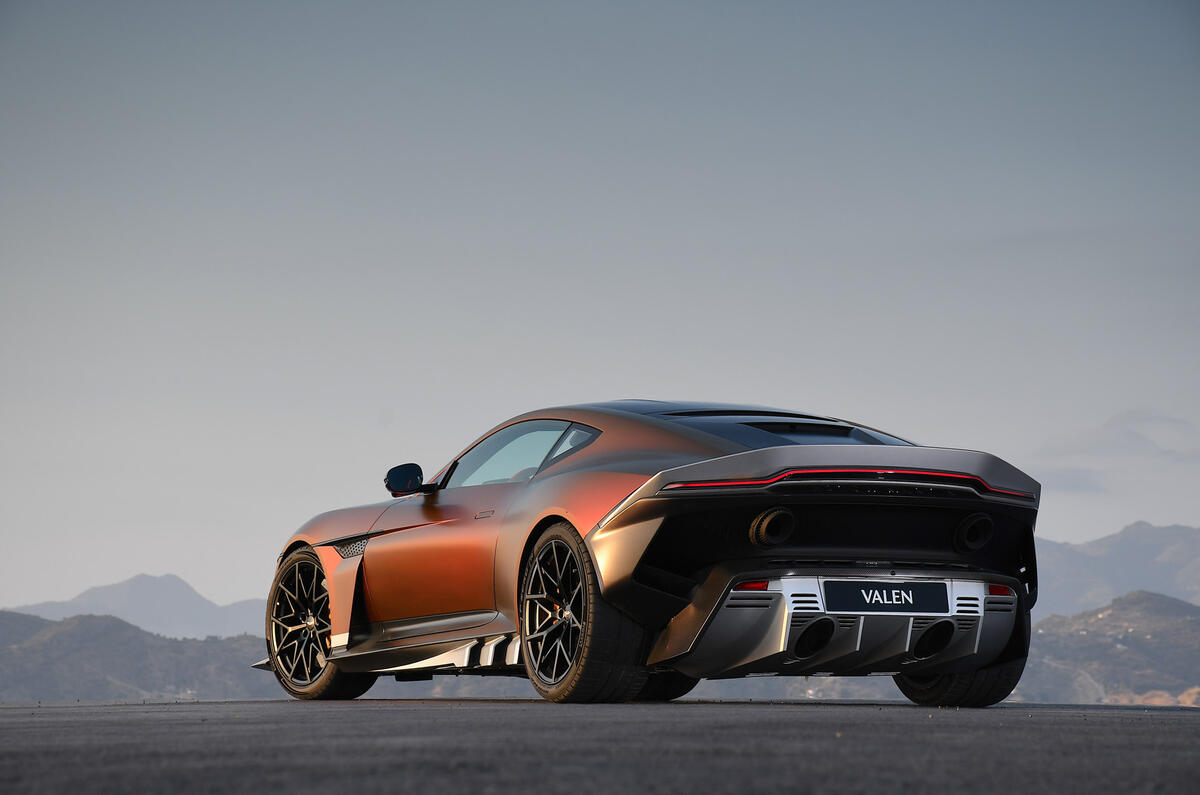
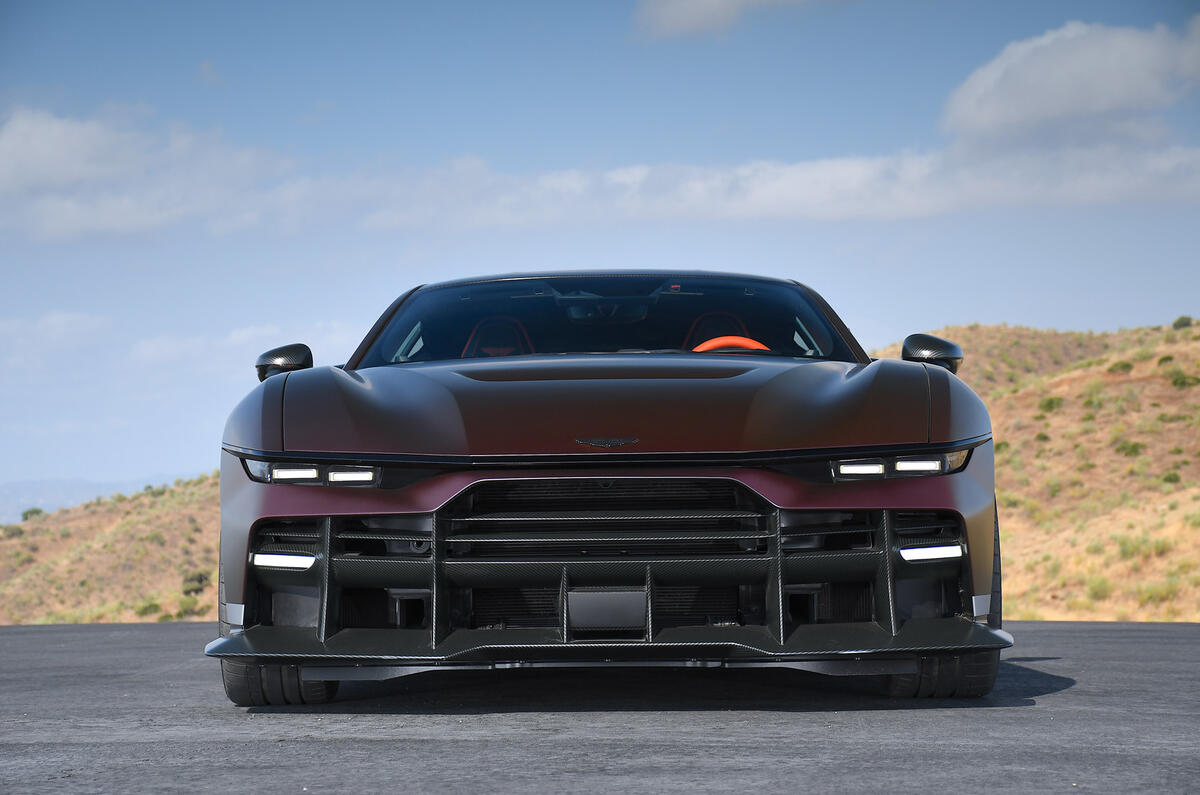
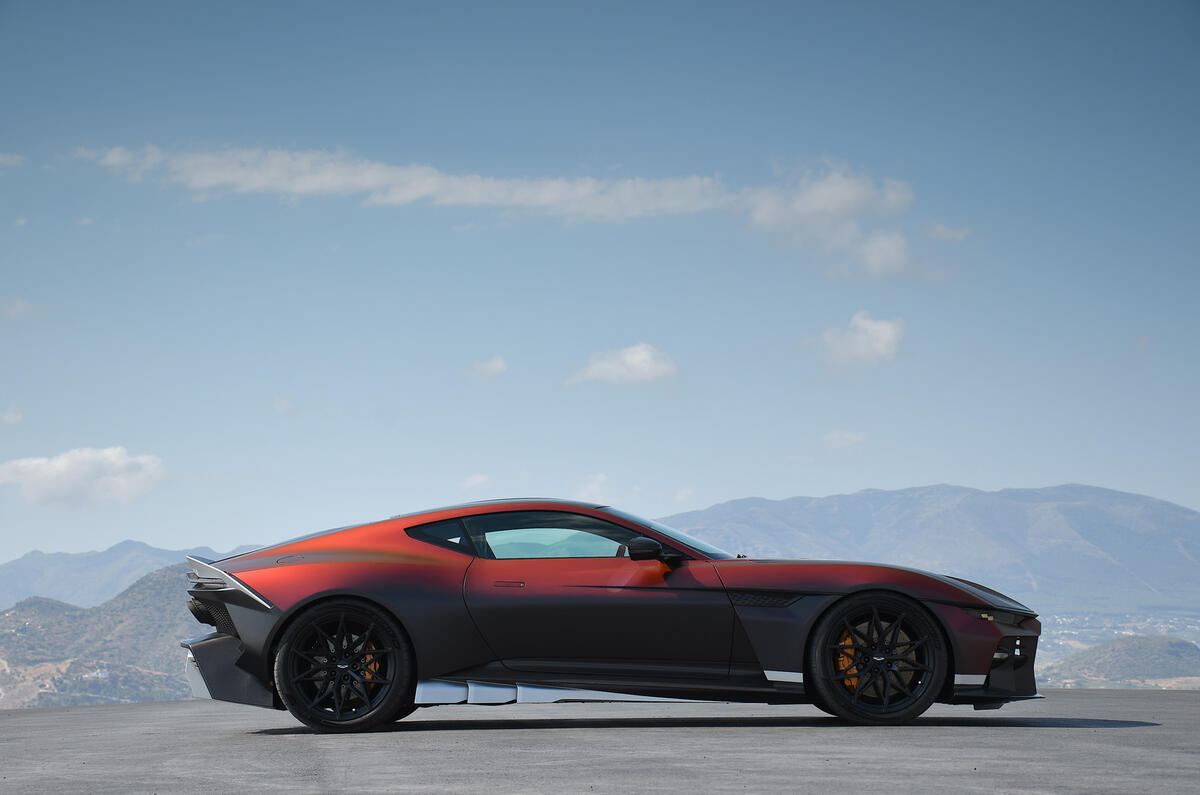
The Valen generates its aerodynamic load through bodywork rather than bolt-on hardware, which is the single most interesting engineering decision on the car. There is no rear wing. Instead the tail sweeps upward and acts as a Gurney flap, producing downforce while incurring minimal drag, an approach Aston Martin chose specifically to avoid motorsport-style aero on a road car.
Working with it are a multi-part front splitter, complex three-part side skirts, angular side strakes, a ducktail spoiler and a substantial rear diffuser that leaves the 325-section rear tyres fully exposed. The effect from behind is closer to a GT racer than to a grand tourer.
- Upswept tail: functions as a Gurney flap, downforce with minimal drag
- Splitter: multi-part, feeding the underbody
- Side skirts: three-part, managing flow along the flanks
- Rear: ducktail spoiler plus a large diffuser, rear tyres left exposed
Chassis: Solid-Mounted, Semi-Active, Deliberately Firmer
Underneath, the Valen is not simply a Vanquish with new clothes. The rear subframe is solid-mounted, the springs and helper springs are model-specific, and Bilstein DTX semi-active dampers handle the compromise between a car that has to work on a road and one that generates real downforce.
Lateral stiffness is up at both ends, which reduces roll and pitch and is what gives the Valen its more agile responses. Braking comes from 410 mm front and 360 mm rear carbon ceramic discs, with the booster retuned for a firmer pedal and finer modulation than the standard V12 car offers.
The Soundtrack Is Engineered, Not Incidental
Aston Martin tuned the Valen's exhaust note as carefully as its aerodynamics. The titanium system has active valves that open progressively up to 3,500 rpm, with the upper exits permanently open and the lower pair valved according to drive mode. The tailpipe finishers themselves are formed from 3D-printed titanium.
The tuning brief was to reduce lower frequencies and amplify the higher ones, with system dimensions optimised to build toward a crescendo rather than deliver a flat wall of noise. In a market moving steadily toward hybrid and electric performance, a naturally aspirated-sounding twin-turbo V12 built for acoustics is a statement in itself.
With more power, less weight, and a spectacular soundtrack, the dramatic design is backed up by equally dramatic performance. - Adrian Hallmark, Chief Executive, Aston Martin
Inside: Lighter, Tighter, 3D-Printed
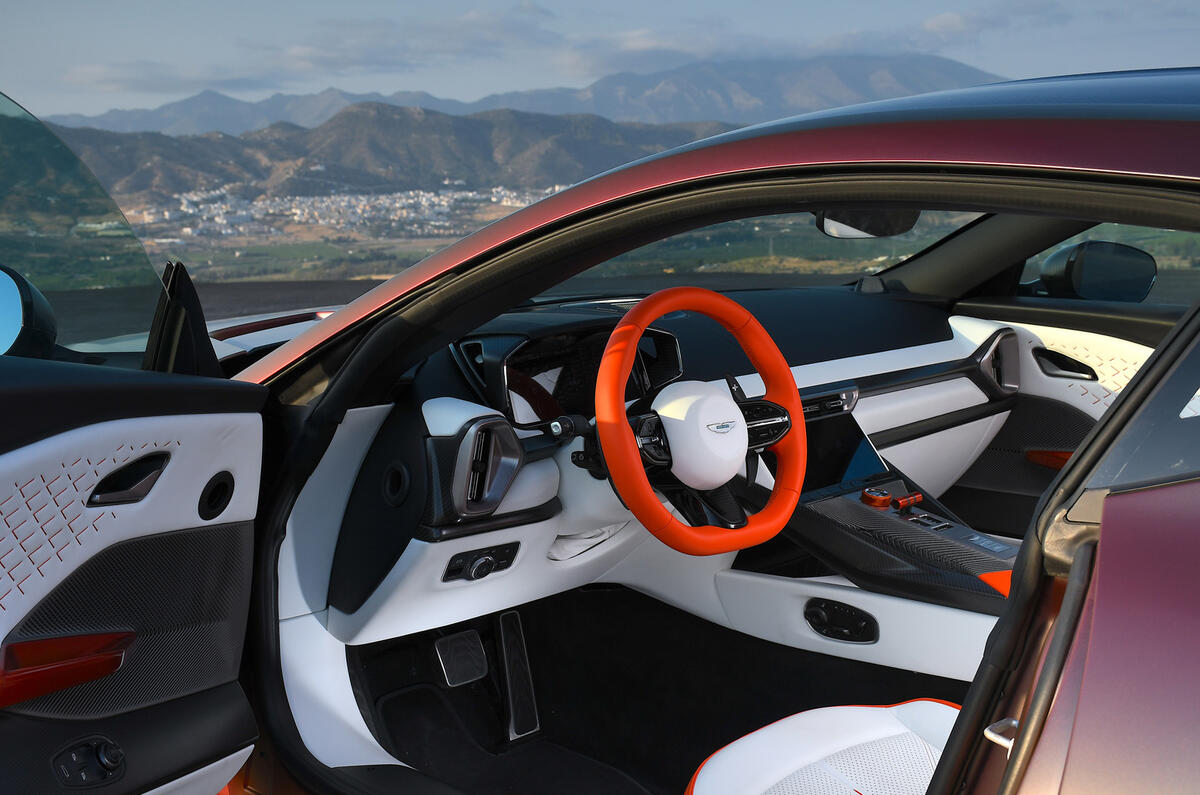
The cabin is where the Valen's discipline becomes most visible. The centre console is noticeably slimmer than the Vanquish's and makes extensive use of a 3D-printed metal that combines aluminium's lightness with titanium's strength. Buyers choose between body-hugging sports seats and lighter carbon fibre performance seats, which is effectively a choice between grand touring and track days.
None of this is austerity. The Valen is still a Q by Aston Martin commission, which means leather, trim, stitching and finish are specified car by car, and no two of the 150 will leave Gaydon identical.
Where the Name Comes From
Valen is drawn from the Latin valens, meaning strong or powerful, which makes it a fairly literal choice for the most powerful front-engined V12 the company has built. It also continues Aston Martin's long-running dynasty of V names: Vantage, Vanquish, Virage, Vulcan, Valkyrie, Valhalla, Valour, Valiant and now Valen.
How the Valen Compares
| Model | Engine | Power | Gearbox | Build run |
|---|---|---|---|---|
| Aston Martin Valen | 5.2L twin-turbo V12 | 838 hp | 8-speed automatic | 150 |
| Aston Martin Vanquish | 5.2L twin-turbo V12 | About 824 hp | 8-speed automatic | Series production |
| Aston Martin Valour | 5.2L twin-turbo V12 | About 705 hp | 6-speed manual | 110 |
| Aston Martin Valiant | 5.2L twin-turbo V12 | About 745 hp | 6-speed manual | 38 |
| Ferrari 12Cilindri | 6.5L naturally aspirated V12 | About 819 hp | 8-speed automatic | Series production |
The comparison that matters most is with the Vanquish, since the Valen shares its V12 and its front-engined layout. The Valen adds roughly 14 hp, removes up to 110 kg, replaces the bodywork entirely, stiffens the chassis, and limits itself to 150 cars. That combination is what separates a series production flagship from a Q commission.
Price, Production and Availability
The Valen starts at roughly £1.5 million, or about $2 million, before a single option is chosen, which at the fixed dirham peg is close to AED 7.35 million. Because every car is a bespoke commission through Q by Aston Martin, the realistic delivered figure sits meaningfully above that.
Production is capped at 150 cars for the world, and reporting around the Monterey debut indicated the run was already allocated by the time the covers came off. Aston Martin has nonetheless opened a public configurator for the model. Deliveries in major markets begin in the second quarter of 2027.
- Build run: 150 cars worldwide, each a bespoke commission
- Starting price: about $2 million (roughly £1.5 million, close to AED 7.35 million at the peg)
- First deliveries: Q2 2027
- Debut: Monterey Car Week, August 2026
Why the Valen Matters in the Gulf
A 150-car run priced around $2 million lands squarely in the region's core collector market. The GCC has been one of the most reliable destinations for Aston Martin's limited V12 specials, and the reasons are structural rather than sentimental: a concentration of buyers with existing marque relationships, a climate and road network that suits a high-speed grand tourer, and a resale market deep enough that scarcity holds its value.
The Valen's specification also reads as if it were written for the region. Rear-wheel drive, a large-capacity twin-turbo V12 rather than a highly strung naturally aspirated unit, adaptive semi-active dampers, and a body that makes downforce without a wing add up to a car that works on a long, fast, warm road. Our piece on the new golden age of GCC-spec supercars covers why manufacturers increasingly build with this market in mind.
For buyers who have not commissioned a limited-run car before, allocation matters more than money: cars like this are offered to established clients first, and the paperwork, import and registration path has its own requirements. Our collector's guide to buying a limited-edition hypercar in the UAE sets out how that process actually runs.
The Verdict
The Valen is not a transitional car or a farewell tour. It is Aston Martin arguing, with 838 hp and 110 kg of removed mass, that the front-engined V12 grand tourer still has a performance ceiling worth chasing. Whether it is the fastest thing in a straight line is beside the point: on the specific metric of front-engined production power, nothing else on sale gets close.
If your shortlist runs wider than one car, our rankings of the fastest cars in the world and the most expensive cars in the world put figures like these in context, and the best luxury sports cars of 2026 covers what the tier below offers. When you are ready to compare cars you can actually buy today, browse the current luxury and performance cars for sale.
Specifications reflect Aston Martin's published figures for the Valen as announced in August 2026, with comparison data drawn from manufacturer releases. Prices exclude personalisation, taxes and local duties, and vary by market and configuration.
Frequently Asked Questions
What is the Aston Martin Valen?
The Valen is a limited-run, two-seat V12 supercar from Q by Aston Martin, revealed at Monterey Car Week in August 2026. It produces 838 hp from a 5.2-litre twin-turbo V12, which Aston Martin says makes it the world's most powerful front-engined production car and the most powerful front-engined car the company has built in 113 years.
How much does the Aston Martin Valen cost?
About $2 million, or roughly £1.5 million, before personalisation. At the fixed dirham peg that is close to AED 7.35 million. Every Valen is a bespoke commission through Q by Aston Martin, so the delivered price of an individually specified car sits well above the starting figure.
How many Aston Martin Valens will be built?
150 cars worldwide. Reporting around the Monterey debut indicated the entire run had been allocated before the car was shown publicly, which is normal for Aston Martin's V12 specials. For comparison, the Valour was limited to 110 cars and the Valiant to 38.
How fast is the Aston Martin Valen?
Aston Martin quotes 0-60 mph in 3.0 seconds, 0-100 km/h in 3.1 seconds, and a top speed of 214 mph (344 km/h). Those figures come from 838 hp and 738 lb-ft with no hybrid assistance, in a car up to 110 kg lighter than Aston Martin's core V12 architecture.
Is the Valen the most powerful Aston Martin ever made?
No, but it is the most powerful front-engined one. The mid-engined, hybrid-assisted Valkyrie and Valhalla both produce more total output. The Valen's claim is specific: the most powerful front-engined production car in the world, and the most powerful front-engined Aston Martin in the company's history.
Does the Aston Martin Valen have a manual gearbox?
No. Unlike the Valour and the Valiant, which were built around a six-speed manual, the Valen uses an eight-speed ZF transaxle with shift programming influenced by Aston Martin's Vantage GT4 race cars. Drive is to the rear wheels only.
What engine does the Aston Martin Valen use?
The most powerful version yet of Aston Martin's 5.2-litre twin-turbocharged V12, producing 838 hp (850 PS) at 6,500 rpm and 738 lb-ft (1,000 Nm) from 2,500 to 5,000 rpm. There is no hybrid system or electric assistance of any kind.
Is the Valen based on the Aston Martin Vanquish?
It shares the Vanquish's front-engined V12 layout and aluminium structure, but little else is carried over untouched. The Valen has all-new carbon fibre body panels, a solid-mounted rear subframe, model-specific springs and Bilstein DTX semi-active dampers, higher lateral stiffness, magnesium wheels, a titanium exhaust and a slimmer interior console.
When will Aston Martin Valen deliveries begin?
Deliveries in major markets are scheduled for the second quarter of 2027, roughly three quarters after the car's August 2026 reveal at Monterey Car Week.
What does the name Valen mean?
It comes from the Latin valens, meaning strong or powerful. The name continues Aston Martin's dynasty of V nameplates alongside Vantage, Vanquish, Virage, Vulcan, Valkyrie, Valhalla, Valour and Valiant.
Does the Aston Martin Valen have a rear wing?
No. Aston Martin generates downforce through the bodywork instead: the tail sweeps upward and acts as a Gurney flap, supported by a multi-part front splitter, three-part side skirts, a ducktail spoiler and a large rear diffuser. The stated aim was real aerodynamic load without motorsport-style wings on a road car.
Can you buy an Aston Martin Valen in the UAE?
Allocations for cars like this go to established clients through official dealers rather than being openly offered, and the 150-car run was reported as fully allocated at launch. Later examples reach the market through private sale and specialist brokers, which is where most Gulf collectors acquire limited-run V12 Astons.


