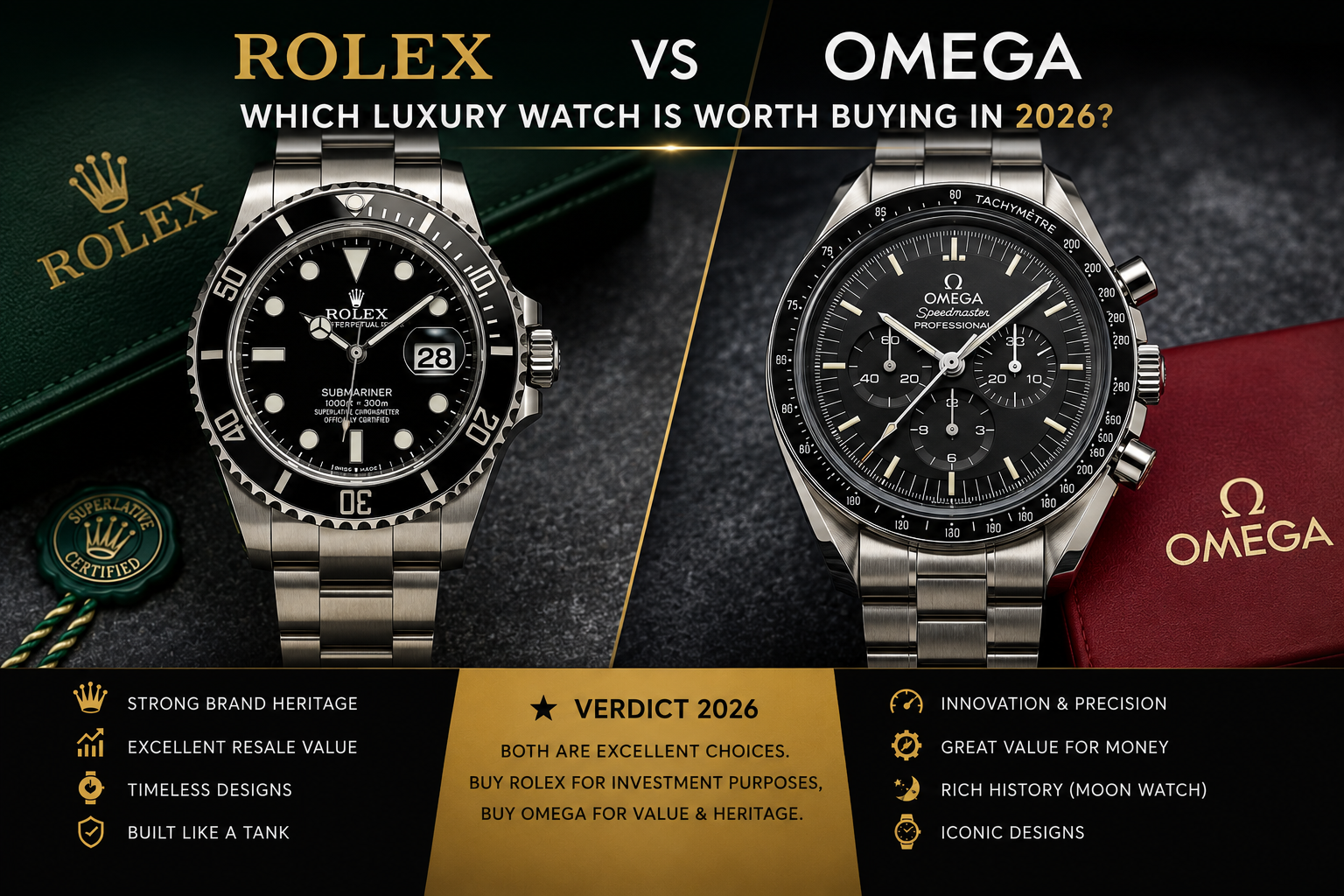
Few debates in the watch world are as enduring as Rolex versus Omega. Both are giants of Swiss watchmaking with over a century of history, both produce genuinely excellent in-house movements, and both make some of the most recognizable watches on the planet. Yet the two brands appeal to meaningfully different priorities. Here's how they actually compare in 2026.
Brand Positioning
Rolex has built its identity around exclusivity, controlled supply, and near-universal recognition. Owning a Rolex - particularly a steel sports model - signals status in a way that transcends the watch community itself. Omega, by contrast, leans on genuine technical and cultural credentials: it was the first watch on the moon, and it remains the watch worn by James Bond. Omega positions itself as offering comparable (and in some technical respects, superior) engineering at a more accessible price point.
Price Comparison
At retail, Omega is generally the more affordable brand across equivalent categories. A Rolex Submariner and an Omega Seamaster Diver 300M occupy a similar space in terms of positioning, but the Omega typically retails for meaningfully less. However, this comparison flips on the secondary market: Rolex sport models frequently sell above retail due to waitlists and scarcity, while most Omega models can be found at or below retail, even new.
Movement Technology
This is where Omega arguably has a genuine technical edge. Omega's Co-Axial escapement, developed with independent watchmaker George Daniels, reduces friction compared to the traditional Swiss lever escapement used in most Rolex movements. Omega's Master Chronometer certification (via METAS) also requires resistance to magnetic fields up to 15,000 gauss - a considerably higher standard than Rolex's in-house chronometer certification, which focuses primarily on timekeeping accuracy rather than magnetic resistance.
That said, Rolex movements are renowned for their simplicity, durability, and long service intervals, and Rolex's manufacturing tolerances remain among the tightest in the industry.
Resale Value
This is the category where Rolex decisively pulls ahead. Steel Rolex sports models - the Submariner, Daytona, and GMT-Master II in particular - are the most consistent performers on the secondary market in the entire watch industry, frequently trading above their original retail price. Omega watches, with the notable exception of certain Speedmaster references tied to space history, generally depreciate at rates closer to the rest of the luxury watch market. For the full picture, see our guide to the best watch brands for investment and resale value.
Waitlists and Availability
Rolex's biggest practical drawback for new buyers is availability. Popular steel sports references are frequently subject to long waitlists at authorized dealers, pushing many buyers toward the pre-owned market at a premium. Omega, by contrast, is widely available at retail with little to no wait, making it a far less frustrating buying experience for someone who wants a watch now rather than in a year or two.
Design Philosophy
Rolex's design language has remained deliberately consistent for decades - recognizable, conservative, and built around a handful of iconic references that rarely change dramatically. Omega, while still respectful of its own heritage, tends to experiment more with dial colors, materials, and limited editions, giving buyers more variety to choose from within a single collection like the Seamaster.
Which Brand Is Right for You?
Choose Rolex if:
- Resale value and long-term investment potential matter to you
- You want the most universally recognized luxury watch brand in the world
- You don't mind waiting for the reference you want
Choose Omega if:
- You want superior magnetic resistance and cutting-edge movement technology
- You want more choice and availability without a waitlist
- You want strong Swiss watchmaking credentials at a lower price point
- You care more about the watch itself than its resale performance
If this is your first serious purchase, you may also want to read our guide to the best entry-level luxury watches for first-time buyers.
Head-to-Head Model Comparison
| Category | Rolex | Omega |
|---|---|---|
| Dive Watch | Submariner | Seamaster Diver 300M |
| Everyday / Dress-Sport | Datejust | Aqua Terra |
| Chronograph | Daytona | Speedmaster Moonwatch |
| Resale Strength | Very strong | Moderate (Speedmaster stronger) |
| Movement Innovation | Reliable, conservative | Co-Axial, higher magnetic resistance |
| Availability | Often waitlisted | Generally available |
The Bottom Line
Neither brand is objectively "better" - they simply reward different priorities. Rolex is the safer choice if resale value and brand prestige are top of mind. Omega is the smarter choice if you want more advanced movement technology, greater variety, and immediate availability at a lower price. Many serious collectors ultimately own both, precisely because the two brands complement rather than replace each other. Browse both in the Gulf Edition watches marketplace.
Frequently Asked Questions
Is Rolex or Omega the better investment?
Rolex generally performs better as an investment, particularly its steel sports models like the Submariner and Daytona, which frequently sell above retail on the secondary market.
Which brand has better movement technology, Rolex or Omega?
Omega's Co-Axial escapement and METAS Master Chronometer certification offer greater resistance to magnetic fields than most Rolex movements, giving Omega a technical edge in this specific area.
Why is it hard to buy a new Rolex?
Popular Rolex steel sports references are produced in limited quantities relative to demand, creating waitlists at authorized dealers. Omega does not typically have this issue.
Is Omega considered a real luxury watch brand compared to Rolex?
Yes. Omega has over 175 years of watchmaking history, its own in-house movements, and a strong track record including being the first watch worn on the moon, making it a legitimate peer to Rolex in terms of craftsmanship.
Should a first-time luxury watch buyer choose Rolex or Omega?
Omega is often recommended for first-time buyers due to easier availability and lower prices, while Rolex may require more patience and a higher budget to acquire the exact reference you want.