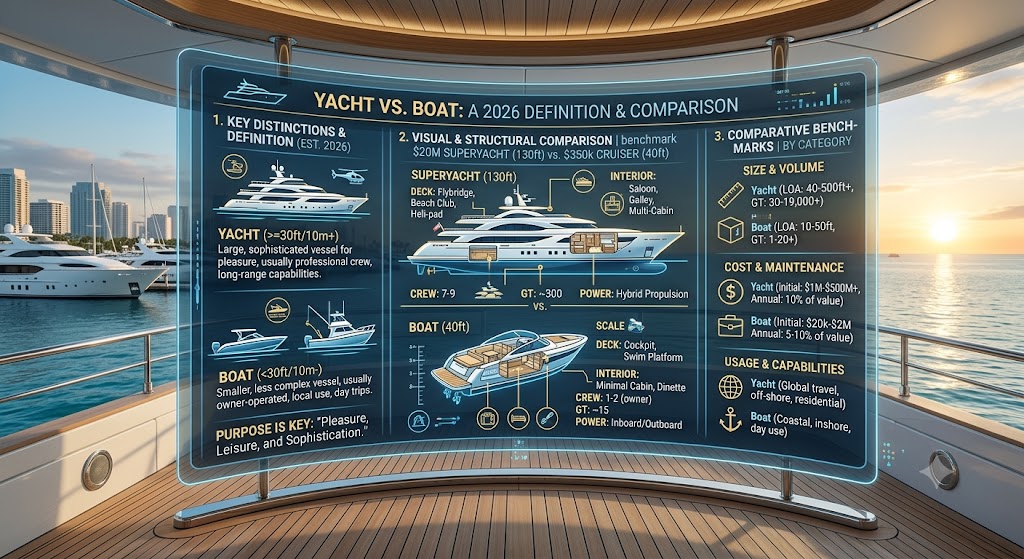
Every yacht is technically a boat, but not every boat is a yacht. The difference comes down to three things: size, purpose, and luxury, not any single official rule. Here's how to actually tell them apart.
The Short Version
"Boat" is the umbrella term for almost anything that floats and moves on water, from a kayak to a fishing skiff to a 40-foot cruiser. "Yacht" is a more specific category within that umbrella: a private, recreational vessel, sail or motor-powered, built for comfort, leisure, and typically longer stays on the water, usually starting somewhere around 35 to 40 feet.
There's no single legal cutoff. Ask ten people in the industry where "boat" ends and "yacht" begins, and you'll get ten slightly different answers. But three factors consistently separate the two.
1. Size (the loosest rule, but the most common one)
Most working definitions put the line somewhere between 30 and 40 feet. Below that, a vessel is almost always called a boat, regardless of how nice it is. Above roughly 40 feet, and especially once features like private cabins, a galley, and separate living areas appear, "yacht" starts to apply. Vessels over 79 feet (24 meters) move into "superyacht" territory, and past about 165 feet (50 meters), "megayacht."
2. Purpose: Activity vs. Comfort
This is the distinction insiders actually care about more than length. A boat is generally built to do one thing well: fish, race, water-ski, ferry people short distances. A yacht is built for a different job entirely: to be lived on. That shift shows up in the design itself, enclosed staterooms instead of an open cockpit, a full galley instead of a cooler, air conditioning, multiple heads (bathrooms), and enough range and stability for multi-day or multi-week trips rather than a single afternoon out.
3. Crew and Complexity
Most boats are designed to be operated by their owner alone. Once a vessel needs a professional captain, and, at larger sizes, a full crew of deckhands, stewardesses, and engineers, it's functioning as a yacht regardless of what the paperwork calls it. This is also where the cost structure changes: a boat's ongoing costs are mostly fuel and storage, while a yacht's ongoing costs include salaries, provisioning, and dockage on top of maintenance. Our guide to how much a yacht costs breaks those running costs down in detail.
Where the Line Gets Blurry
A 45-foot sportfishing boat rigged for tournament fishing is still usually called a "boat" despite exceeding the size threshold, because its purpose remains utilitarian. Meanwhile, a well-appointed 32-foot cruiser with a cabin and small galley sometimes gets called a "yacht" informally, even below the typical size cutoff. In practice, people use both words fairly loosely in conversation, you're not wrong to call a friend's 22-foot fishing boat a "yacht" as a joke, and no one will correct you.
Yacht vs. Boat vs. Ship
Since the confusion doesn't stop at two words, here's the third category. A ship is a large, typically commercial or military vessel, cargo ships, tankers, cruise ships, naval vessels, generally over 500 gross tons and built to transport people or goods rather than for private leisure. Unlike boats and yachts, ships are subject to more formal international regulatory frameworks, like the IMO's SOLAS conventions.
So the full hierarchy runs from boat (the general term) to yacht (a private, leisure-focused subset) to ship (large-scale, commercial or military, and separately regulated), with some overlap, since a large enough commercial charter yacht can brush up against ship-adjacent regulation.
Quick Reference Table
| Boat | Yacht | Ship | |
|---|---|---|---|
| Typical length | Under ~40 ft | ~40 ft to 300+ ft | Often 500+ gross tons |
| Purpose | Fishing, sport, utility, short trips | Leisure, comfort, extended stays | Commercial or military transport |
| Crew | Usually owner-operated | Captain, often full crew | Professional crew, regulated manning |
| Regulation | Minimal | Yacht-specific codes at larger sizes | Formal international maritime law |
Why the Distinction Actually Matters
This isn't just semantics. Insurance underwriters, marina operators, and charter regulators all use size and classification to determine requirements. A vessel crossing from "boat" into "yacht" territory can trigger different licensing rules, crew certification requirements, and insurance categories depending on the jurisdiction. If you're buying, chartering, or registering a vessel, it's worth confirming how your specific country or state defines the cutoff rather than relying on general industry convention.
Ready to move from definitions to real vessels? Explore the Gulf Edition luxury yachts collection or browse yachts for sale.
Frequently Asked Questions
Is a sailboat a yacht?
It can be. "Sailing yacht" is a standard industry term for larger, cabin-equipped sailboats built for cruising rather than day sailing or racing. A small dinghy or racing sailboat, on the other hand, is just a boat.
What's the smallest size that counts as a yacht?
There's no official minimum, but most industry usage puts the starting point somewhere around 35 to 40 feet, combined with genuine yacht-style amenities such as cabins, a galley, and a head, rather than length alone.
Is a houseboat a yacht?
Generally no. Houseboats are built primarily for stationary or slow-water living rather than cruising performance, which puts them in their own category rather than under "yacht."
Why do people call small boats "yachts" jokingly?
It's a long-running bit of boating culture. Calling a modest boat a "yacht" (or the reverse) is a common tease, precisely because the line between the two is genuinely fuzzy.
Does the size of the crew determine if something is a yacht?
Not by itself, but it's a strong signal. A vessel requiring a licensed captain and dedicated crew is almost always functioning as a yacht rather than a boat, regardless of exact length.
At what point does a yacht become a ship?
There's no exact crossover, but once a vessel exceeds roughly 500 gross tons or is used for commercial or large-scale charter operations rather than purely private leisure, it starts falling under ship-level regulatory frameworks rather than yacht-specific codes.
.jpg)

